

“Mamlambo in Waterfall City” is a powerful example of writing research Otherwise. It is chapter 15 by Ujithra Ponniah in a collection Johannesburg from the Riverbanks. Navigating the Jukskei. *
Ujithra takes us along the Jukskei river, which she re-names Mamlambo, after the Serpentine Goddess who rules over it. The water is sentient as it runs through the poverty and debris of Alexandra Township, with its open sewer drains, and flows into the opulence of the gated Waterfall City.
Ujithra boldly gathers into conversation an assemblage, without regard for commonplace categories and classifications. She tells us that the Jukskei River acts “as a connecting tissue, bringing unequal landscapes of people, property, infrastructure, meaning, value, actors, and institutions together.”
We have Ujithra’s fieldnotes, usually deleted from view; indigenous knowledge systems; legacies of Apartheid; Patriarchy and Capitalist private property regimes; alongside water control with its technologies of diversions of river routes and filtering devices.
Mamlambo is a non-binary (pronouns they, them), occult force – horse, fish and snake – under whose gaze these worlds clash and collude, providing a score for the cacophony of inequalities that continue to bedevil us.
I picture them with their synapses in their trillions, lighting up their slithery snaky snarkiness and enabling the terrifying, magical, violent, connections across an infinity of forces.
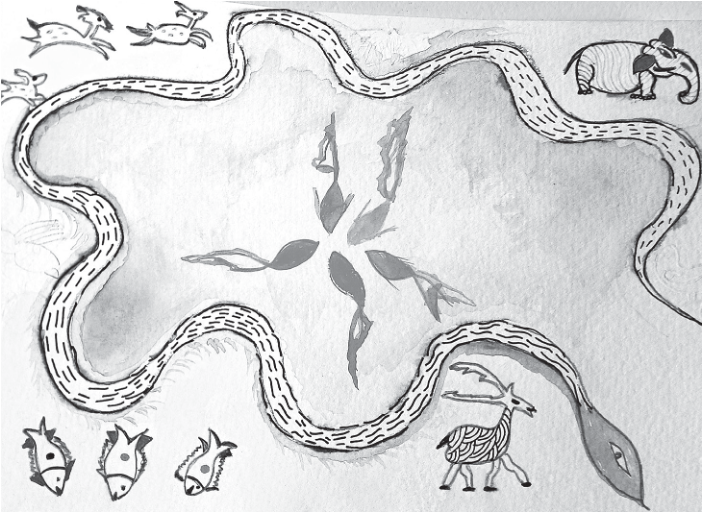
Mamlambo – The river goddess. Sketch by author
They dispense wealth and good fortune to their devotees, but as is to be expected, they exact a Faustian price. An opaque aura of foreboding hangs over Ujithra’s description of pipes, chemicals, an ozone plant and bio-enzymes.
There is a fake lake of diverted Mamlambo waters, with a constructed tiny island on which tall trees have been dropped by helicopter. Workers in pairs have to canoe across to water this landscaped theatre.
A worker drowned.
Fellow workers planted a commemorative tree to the death of Africa Chauke, aged 23. In a sad, poignant, concluding moment, Ujithra suggests that Mamlambo has exacted her price, with Africa Chauke as sacrifice –
“Once again it was the working class that was being made to pay for the wealthy.”
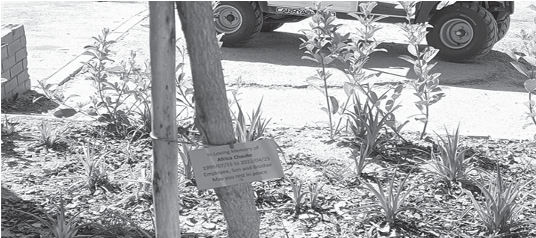
Photograph by the author.
* Johannesburg from the Riverbanks. Navigating the Jukskei, edited by Mehita Iqani and Renugan Raidoo, HSRC Press, 2025.
Ujithra Ponniah’s recently published book is Becoming Agarwal: The Manufacture of a Close-Knit Mercantile Caste. Cambridge University Press, 2026.