
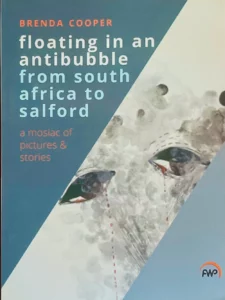
AntiBUBBLE
Opening Vignette

Peeling Carrots.
I cut my finger peeling carrots. Drops of tar spring from the cut and stain the floorboards. Trying to clean it up, I make a hole in the floor. In the room below there’s a university meeting. I’m among the professors. Looking up, I discover myself spying. That’s what you get for peeling carrots, I tell myself, very angry.
Ana Maria Shua, Microfictions.
I was always a down-to-earth carrot-peeling onion-weeping kind of professor, who was among my peers and also peering at them from outside. This mosaic book of fragments is about many worlds and the rabbit warrens that connect them, sometimes miraculously so, and sometimes to ill effect. It is about spying on myself and others, about being among professors and not, about feeling angry – and sad and sorry and euphoric. And about carrots, bags and shoes.
It is about making sense of the non-sense of bleeding black tar and of the impossibility of cleaning up the muck. It is about the magical and the mundane and the allure of alliteration; a professor peeling, sad and sorry, bleeding black, magic and mundane, a lure that is a language with which to take risks, befitting the feat of dropping through a hole in the floor, a hole formed by the cut and stain of drops of tar. Onto newly tarred road perhaps?
Looking up at my carrot-peeling, tar-bleeding doppelganger, I leave the company of professors and escape in an antibubble from Cape Town, South Africa, where I have lived and worked for nearly three decades, to Salford in Greater Manchester, England.

Wangechi Mutu. Born in Nairobi and lives in Brooklyn, New York. Death by Mariposa 2006 Ink, acrylic, collage, contact paper on Mylar, 17 x 25 1/5 inches.
Image courtesy of Wangechi Mutu and Gladstone Gallery, New York.
I have always believed that finding one’s way is to unravel the knots, the mish and the mash, as issues become confused and linked and symbiotic. I am dyspraxic – have no spatial memory – and get lost. I have always needed the scaffolding of structure in all contexts – professional, personal, political – before trying to grasp the combined and sometimes unrehearsed choreography of living. The humility pie that I am ready to eat in the sixth decade of my life is that it is not always possible to clean up the mess, which has eroded the floor into a gaping hole, which may be a pathway or a punishment.
But with the antibubble fully inflated, the goo below suggests that all this may be no more than hot air unless a compass of sorts curtails free flight.
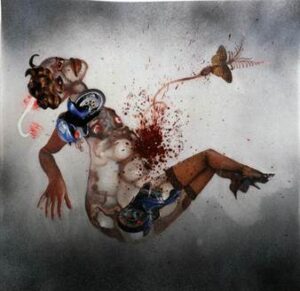
Wangechi Mutu Untitled 2004 Mixed media painting and collage on vellum 44,5 x 47cm [17 7/8 x 18 ½ inches]
Courtesy of Wangechi Mutu.
My compass will be writers and artists, some white and middle aged like me, most diasporic youngish women, who are living in London, Antwerp or New York, but whose parents – one or both – were born in Africa. They are like Wangechi Mutu, whose fabulous fantasies speak to me. I will try to follow them where they go. I will work on my terms and on theirs and allow my own shticks and shtones to surface, catalysed by their provocations and provocative performances of colour, paint, poetry, drama, novels in verse and poetic fictions.
I am a white South African, whose parents came from Eastern Europe and Russia, making them diasporic in a way I never felt myself to be. But I was bewildered by the Anglo-Saxon benchmark of many of my friends. Born and bred in Africa, I could not really claim to be an African. Perhaps we whites are Creoles of a kind. My father was a convicted pornographer on a suspended prison sentence and my mother suffered from a degenerative chronic illness. I lapsed as a Jew to spite them both in their inability to learn lessons about Nazi prejudice in South Africa.
Marlene Dumas, fellow white South African, hits all my worst fears and bad South African buttons. And yet, she speaks to me in my own most secret voice. She maps out this book for me
“Where, asks Dumas, is the meaning of something? How do you stack up what is going on outside, in the world, against your own personal fears? How do you take Afghanistan and the Taliban and Snow White and the Seven Dwarfs in the same lifetime and have them convey a new mythology, a personal one? Can you measure your own grave by extending your arms like an angel, a wingspan away from understanding? Can you control every last bit of your destiny, down to the size of your coffin?”
http://www.huffingtonpost.com/patricia-zohn/culture-zohn-marlene-duma_b_108975.html

Marlene Dumas. Born in Cape Town and lives in Amsterdam. Measuring your own grave.
2003 140 x 140 cm oil on canvas.
Photo Peter Cox courtesy Zeno X Gallery, Antwerp
Copyright Marlene Dumas.
A wingspan away from understanding. The vast span of the wing separates your own tiny, gargantuan life from the flow of the world. This may appear to inflate your idiosyncratic concerns, but it is only by way of the endeavour of measuring your own grave that you can approach the vastness of the planet. I think.
This book will also bulge with foxes, wolves, Riding Hoods, Apartheid and ancestors having a mid life crisis –
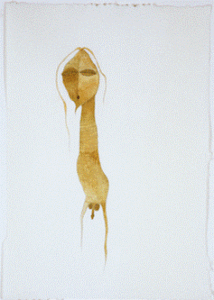
Marcia Kure. Born in Kano, Nigeria, lives in Princeton NJ. Untitled I (Ancestor Undergoing Mid-Life Crises), 2004
Kolanut Pigment, Ink, Watercolor and Pencil 11x 7 Inches
Courtesy and copyright Marcia Kure.
Its stories are European, African and hybrid, mangled and manoeuvred by artists and writers, who are depicting their lives and performing their humanity.
I am a professor, a mother, a divorcee and a wife. My first baby died in a cot death and I found him with his tiny face flattened and grotesque and horrible.
I have studied African fiction written in English for over thirty years, as my anchor and my home. I am neither really Jewish anymore nor legitimately African, neither diasporic, nor settled citizen. This is my effort to fly or fall and to understand the meaning of being human and of how peeling the carrots played its part. The hole in the floor – portal to some self knowledge – was perhaps the reward for being a carrot-peeling professor, with my feet firmly on the ground. Or not, as it now seems.
What it means to be human, then. Not a small question. Writers and artists, many dispersed across the planet, help me to imagine it; artists such as Julie Mehretu.

Julie Mehretu. Born in Ethiopia and lives in New York. Dispersion.
Ink and acrylic on canvas 228.6 x 365.8 cm
Photo Credit: Erma Estwick Private Collection Courtesy of the artist and Marian Goodman Gallery, New York. Copyright Julie Mehretu.
Mehretu embodies the restless migrations that characterise our times and our humanity. She paints big canvasses, and composes them out of tiny, uneven mosaic bits. Do you see the aeroplane caught in the turbulence at the bottom left of the painting? I am a passenger inside that tiny blue plane, on my journey from South Africa to Salford in England.