
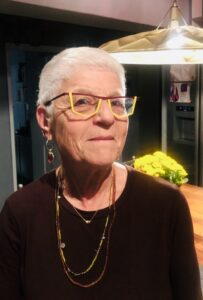
BRENDA COOPER
CURRICULUM VITAE
PERSONAL
Name: Brenda Cooper
burnishwriting@gmail.com
Current Positions: Emeritus Professor, Centre for African Studies, University of Cape
Town
Director of BURNISH, a writing consultancy
QUALIFICATIONS AND AWARDS
1971: BA degree with English and History majors, University of Cape
Town.
1975: M.A. degree by thesis, University of Birmingham, UK.
Thesis title: A Survey of Modern Black African Fiction with Reference to
Independent African and South African Works.
1982: Ph.D. degree University of Sussex, UK.
Thesis title: A Theory of African Literature and its Application to Texts
by Wole Soyinka, Ayi Kwei Armah and Ngugi wa Thiong’o.
In 2001: University of Cape Town Fellowship in recognition of my research
accomplishments.
EMPLOYMENT
1983 – 2008: Centre for African Studies and Department of English, University of
Cape Town.
1992 – 2008: Director, Centre for African Studies, University of Cape Town
2008 – 2010: Consultant, mid-career development programme, Research Office,
University of Cape Town
2011 – 2015: Honorary Research Associate, University of Manchester
2015 – present: Director, Burnish, An Academic Writing Consultancy, Cape Town
TEACHING AND WORKSHOP EXPERIENCE
I have taught a wide range of courses to students, at both undergraduate and
postgraduate level. Courses focussed on literary theory, African writing and African knowledge production. They were both embedded in literary studies and also spanned multi-disciplinary topics.
I have also supervised the dissertations of a number of Honours, Masters and Ph.D. research students.
I have run workshops for fellow academics to increase their research outputs. To this
end, at the end of 2008 I set up a project in the Research Office of the University of
Cape Town (UCT) entitled The Programme for Enhancement of Research Capacity
(PERC). Its vision was to contribute to UCT’s broader vision of research and
transformation in its commitment to becoming an “Afropolitan” university. That is to
say, its strategic priority of remaining a research led university of excellence, within the
world and within Africa. This broad vision was funded by the Carnegie Foundation and
I set up a series of grants, which stimulate collaborative, cross disciplinary, Africa
centred research, which is also global. I worked across all of the faculties and
departments of the university, encouraging participants from a range of fields.
I also run a consultancy called BURNISH in which I offer workshops for fellow
academics to enhance their research activities and facilitate the completion of their
research projects.
RESEARCH FOCUS
My research is focused on the ways in which knowledge of Africa has been constructed
in a wide range of discourses and disciplines, and particularly in the field of African and
Diasporic literature and literary theory. It contributes to providing a critical understanding
of how knowledge in and about Africa, and the scholarship through which that
knowledge is filtered, has been mediated through the lenses of the colonial and the
Apartheid libraries.
In this light, what I prioritise in my research is the construction new knowledge
paradigms steeped in theory. I endeavour to shift the lenses from Eurocentric to African
models of scholarship, while recognising that African experiences are multiple in
different parts of the continent and the Diaspora. In other words, the questions I am
asking relate to how knowledge, gleaned in the area of cultural and literary studies,
contributes to entrenching or dismantling the power relations, within the historical
context of neo-colonialism and postcolonialism. My research is multidisciplinary and
based on questions of theories of language and identity in African and Diasporic fiction.
Most recently I have been investigating the style and mode of the craft of academic
writing itself in relation to the question of how we write, as academics, in our endeavour
to produce knowledge.
PUBLICATIONS
Books.
• Modern African Writing, Longman, Cape Town 1984.
• To Lay These Secrets Open, David Philip, 1992.
• Debates, Dilemmas and Dreams: Exercises in African and Some Latin American
Writing, Heinemann-Centaur, 1992.
• (ed.) Nations: Stories of the World for Africa, Maskew Miller Longman, 1995.
• (co-edited with Andrew Steyn) Transgressing Boundaries: New directions in the
study of culture in Africa), University of Cape Town and Ohio University Presses,
1996.
• Magical Realism in West African Fiction: Seeing with a Third Eye, Routledge,
1998.
• (ed.) Keys: Unlocking Southern African Stories, Maskew Miller Longman, 2000.
• Weary Sons of Conrad: White Fiction Against the Grain of Africa’s Dark Heart,
Peter Lang Publishers, 2002.
• (ed.) Stories Fly: A Collection of African Fiction Written in Europe and the USA,
David Philip, 2003.
• A New Generation of African Writers: Migration, Material Culture and
Language, James Currey, Oxford, 2008.
• (ed with Morrell, Robert) Africa-Centred Knowledges: Crossing Fields and
Worlds, James Currey, Oxford, 2014.
• Floating in an Antibubble from South Africa to Salford. A Mosaic of Pictures and
Stories. Africa World Press, 2015.
Chapters in Books.
• ‘Underneath the Fists are Open and Vulnerable Eyes’ in Ingrid de Kok and Karen
Press (eds.) Spring is Rebellious, Buchu Books, 1990, p.52 – 56.
• ‘New Criteria for an ‘Abnormal Mutation’? An Evaluation of Gordimer’s A Sport
of Nature’, in Martin Trump, (ed.) Rendering Things Visible, Ravan, 1990, p.68 –
93.
• ‘The West African Magical Realist Novel: Syl Cheney-Coker’s The Last
Harmattan of Alusine Dunbar, Ben Okri’s The Famished Road and Kojo Laing’s
Woman of the Aeroplanes,’ in Lokangaka Losambe (ed.) Introduction to African
Prose Narrative, Kagiso Publishers, 1996.
• ‘Postcolonialism Against the “Empire of the Discipline”‘, Fincham, Gail &
Hooper, Myrtle, (eds.) Under Postcolonial Eyes: Joseph Conrad After Empire,
University of Cape Town Press, 1996.
• ‘Cultural Identity, Cultural Studies in Africa and the Representation of the Middle
Passage’ in Brenda Cooper and Andrew Steyn (eds.) Transgressing Boundaries:
New directions in the study of culture in Africa, University of Cape Town and
Ohio University Presses, 1996.
• “Apes, Gender and Jungle: The Cultural Politics of Marianna Torgovnick and
Donna Haraway”, Ghosh-Schellhorn., M, (Ed.) Writing Women Across Borders
and Categories. Series: Hallenser Studien zur Anglistik und Amerikanistik.
Münster: Lit Verlag Münster, Germany, 2000.
• “Landscapes, Forests and Borders within the West African Global Village”, in
Jamie S. Scott & Paul Simpson-Housley (eds.) Mapping the Sacred: Religion,
Geography and Postcolonial Literatures, Editions Rodopi BV, Amsterdam, April,
2001.
• “Ben Okri” entry in Gikandi, Simon (ed), Encyclopedia of African Literature,
Routledge, London and New York, 2003, 412 – 413.
• “Realism and Magical Realism” entry in Gikandi, Simon (ed), Encyclopedia of
African Literature, Routledge, London and New York, 2003, 458 – 61.
• “The Power of the Pink Hat: Research in Arts and Culture Towards Alleviating
Spiritual Poverty”, in Tessa Marcus and Alexandra Hofmaenner (eds.) Shifting
Boundaries of Knowledge: A View on Social Sciences, Law and Humanities in
South Africa, University of KwaZulu-Natal Press, 2006.
• “Language, Multiple Worlds and Material Culture in the Teaching of African
Migrant Fiction”, in Gaurav Desai (ed) Teaching the African Novel, The Modern
Languages Association of America, 2009, 246 – 258.
• “If the Shoe Fits: Appropriating Identity” in Jackie Stacey and Janet Wolff (eds)
Writing Otherwise: Experiments in Cultural Criticism, University of Manchester
Press, 2013, 121 – 134.
• “Both Dead and Alive: Schrödinger’s Cat in the Contact Zone”, in Thesen, Lucia
and Cooper, Linda (eds.) Risk in Academic Writing: Postgraduate Students, their
Teachers and the Making of Knowledge, Multilingual Matters, 2014, 245 – 251.
• With Morrell, Rob, “The Possibility of Africa-Centred Knowledges”, in Cooper,
Brenda & Morrell, Robert (eds.) Africa-Centred Knowledges: Crossing Fields
and Worlds, James Currey, 2014, 1 – 20.
• “Black Boxes & Glass Jars: Classification in the Hunt for Africa-centred
Knowledge”, in Cooper, Brenda & Morrell, Robert (eds.) Africa-Centred
Knowledges: Crossing Fields and Worlds, James Currey, 2014, 78 – 92.
• “The West African Magical Realist Novel: Syl Cheney-Coker’s The Last
Harmattan of Alusine Dunbar, Ben Okri’s The Famished Road and Kojo Laing’s
Woman of the Aeroplanes”, in Palmer, Eustace & Cole, Ernest (eds.) Emerging
Perspectives on Syl Cheney-Coker, Africa World Press, 2014, 121 – 155.
• ‘The Plantation Blood in His Veins’: Syl Cheney-Coker and The Last Harmattan
of Alusine Dunbar, in Palmer, Eustace & Cole, Ernest (eds.) Emerging
Perspectives on Syl Cheney-Coker, Africa World Press, 2014, 183 – 225.
Journal Articles
• ‘Some Generalisations about the Class Situation of the Writer-Intellectual from
Independent Africa’, in Africa Perspective, No. 16, 1980, p.60 – 79.
• With Linda Cooper, ‘Historical Drama Series; 1922: SATV’ in Social Dynamics
10 (1) 94, 1984, p.94 – 5.
• ‘Chaiba the Algerian versus Our Sister Killjoy: the Case for a Materialist Black
Aesthetic’ in English in Africa, Vol. 12, No. 2, October 1985, p.21 – 51.
• ‘The Value of the Pearl: For Now or Forever? The Question of the Universal in a
Materialist Aesthetic.’ English Academy Review No. 4 1987, p.91 – 114.
• Review Article, ‘Marxism and African Literature’, International Journal of
African Historical Studies, Boston, Vol. 20, No. 1, 1987, p.99 – 101.
• ‘Does Marxism Allow for the Magical Side of Things? Magical Realism and a
Comparison between One Hundred Years of Solitude and The House of the
Spirits’ in Social Dynamics 17 (2), December 1991, p.126 – 154.
• Guest editor with Martin Hall of Theme Issue, ‘Looking at Latin America’ Social
Dynamics 17 (2), December 1991.
• ‘Liberated Repressions: Escaped Thoughts of a White South African Critic’ in
Wasafiri No.19, Summer 1994, p.40 – 50.
• “Syl Cheney-Coker: The Last Harmattan of Alusine Dunbar and an Interview”,
African Literature Association Bulletin, 20, 3, 1994, 3 – 17.
• “The Two-faced Ogun: Postcolonial Intellectuals and the Positioning of Wole
Soyinka”, English in Africa, October 1995, p.44 – 69.
• ‘Why the Bombs Did Not Go Off in the Cinema: The English Patient as fiction
and film’ Social Dynamics, Vol. 23, No.1 Winter, 1997, p.154-167.
• “Snapshots of Postcolonial Masculinities: Alan Hollinghurst’s The Swimmingpool Library and Ben Okri’s The Famished Road”, The Journal of
Commonwealth Literature, Vol. 34, No.1, 1999, p. 135-157.
• Two entries on the Nigerian writers, Ben Okri and Festus Iyayi in Stephen R.
Serafin, (general editor) Encyclopaedia of World Literature in the 20th Century,
St James Press, 1999, p. 428-9 & 521-2.
• “A Boat, a Mask, Two Photographers and a Manticore – African Fiction in a
Global Context”, Pretexts, Vol 9, No.1, July, 2000, p.63 – 76.
• “A Gunny Sack, Chants and Jingles, a Fan and a Black Trunk: The Coded
Language of the Everyday in a Postcolonial African Novel – M.G. Vassanj’s The
Gunny Sack”, Africa Quarterly, 44.3, November, 2004, 12 – 31.
• “Look Who’s Talking? Multiple Worlds, Migration and Translation in Leila
Aboulela’s The Translator, The Translator, Vol.12, No. 2, 2006, 323 – 344.
• “Parallel Universes and Detonating Words: The Brixton Wonderland of Biyi
Bandele’s The Street, Journal for the Study of Religion, Vol. 19, Number 2, 2006,
17 – 40.
• “Banished from Oedipus”: Emecheta’s and Djebar’s Gendered Language of
Resistance” in special issue of Research in African Literatures, 38.2 (Summer
2007), 143 – 160.
• “The Rhetoric of a New Essentialism versus Multiple Worlds: Isidore
Okpewho’s Call Me By My Rightful Name and Buchi Emecheta’s The New Tribe
in Conversation, Journal of Commonwealth Literature, Vol 42 (2), 2007, 19 – 36.
• “Diaspora, Gender and Identity: Twinning in Three Diasporic Novels”, English
Academy Review, Vol. 25 (1), 2008, 51 – 65.
• “Returning the Jinns to the Jar: Material Culture, Stories and Migration in
Abdulrazak Gurnah’s By the Sea” Kunapipi, XXX, (1), 2008, 79-96.
• Entry on Helen Oyeyemi in The Literary Encyclopedia, 23 October, 2008, three
pages [http://www.litencyc.com]
• “The Middle Passage of the Gods and the New Diaspora: Helen Oyeyemi’s The
Opposite House.”, Research in African Literatures, Vol. 40, No. 4, 2009, 108 –
121.
• “Resurgent Spirits, Catholic Echoes of Igbo & Petals of Purple: The Syncretised
World of Chimamanda Ngozi Adichie’s Purple Hibiscus”, African Literature
Today, 27, 2010, 1 – 12.
• “The Signifying Donkey” SAVVY: Art, Contemporary, African, Edition 1, 2010,
108-9.
• “Hunting Factishes and Snarks: The Politics of the Poetics of Nonsense” Axon:
Creative Explorations, Edition 1, http://www.axonjournal.com.au/issue1/hunting-factishes-and-snarks-politics-poetics-nonsense, 2010.
• “Women Dancing on Water: A Diasporic Feminist Fantastic?” in Contemporary
Women’s Writing, Volume 6 No. 2, 2012, 140 – 158.
• “The politics of the genre of academic writing; or, Professor Curtin, Professor
Clegg, and the African Studies network war, The Journal of Commonwealth
Literature © The Author(s) 2015 Reprints and permissions:
sagepub.co.uk/journalsPermissions.nav DOI: 10.1177/0021989415592943
jcl.sagepub.com, 1 – 17.
• “Sightings of a Fox. Anecdotal and Academic Knowledge”, Axon, Issue 9, Vol. 5,
No.2, November 2015. http://www.axonjournal.com.au/issue-9/sightings-fox
• “Eight chickens and there was this goat. Academic Knowledge and Not
knowing”, Wasafiri 31.1 (March 2016) issue number 85. Published online: 25 Feb
2016.
• “Academic Happenstance. A Rubbish Tip, An Owl and a Boojum”, Axon:
Creative Explorations, Vol. 10, No.2, December 2020.
https://axonjournal.com.au/issue-vol-10-no-2-dec-2020/academic-happenstance
• “A Tribute to Harry Garuba (1958 – 2020)”, East African Literary and Cultural
Studies, Vol.7, Issue 3, 2021 171 – 173.
Work in Progress:
Book entitled Passing Through Knowledge Worlds. Writing Against the Grain.
Passing Through
An unidentified,
inconspicuous someone,
smaller than a flea
snuck over my pillow last night,
unbothered by me,
in a big rush, I bet,
to get to his church
and thank his saints.
Charles Simic.
Passing Through Worlds embraces the themes, forms and styles of some writing
which arm wrestles the gatekeepers to admit the multiple dimensions of living
and dying into what counts as Knowledge. It is hospitable to the worlds inhabited
by humans, animals, insects, trees, plants and sacred objects. It is open to
strategies, devices, styles, forms, modes which are fit for the purpose of the risks
and hazards posed by these journeys through worlds. In the process, those
worlds may become loud and visible; in the process, the contributions of their
inhabitants may become recognised, respected and accrue power; in the process
scholars may learn to see and to hear differently; in the process they may learn
to accept their blindness and their deafness. In this way research may contribute
to a more just world, one comprised of many worlds.