

No! Yes.
I am a secular person, but I believe there are many unknown worlds inhabited by humans, animals, insects, trees, plants and sacred objects. There are only fleeting moments of overlap between them. Moments which light up the planet, perhaps.
But in that moment of enchanted overlap, I believe…
PASSING THROUGH. Charles Simic.
An anonymous,
Inconspicuous someone,
Smaller than a flea
Snuck over my pillow last night,
Unbothered by me,
Abject and humble
And in a rush, I bet,
To get to a church
And thank his saints. #
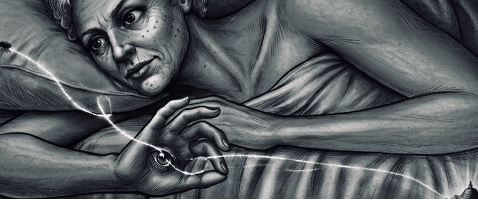
We may only be passing through into other knowledge worlds, but the moment we recognise that tiny, mobile spot on the pillow as a sentient being, it begins to mess with us. It challenges what we think we know, and even who we are.
Historian, Dipesh Chakrabarty, arm wrestles this conundrum. The protocol of his Subaltern Studies commits him to writing history in the interests of the oppressed and impoverished. But spirits, gods and sacred objects are often players in their accounts of the world. These are inadmissible to the trained historian – “[historical] time is godless.” § If peasants claim “to have been inspired to rebellion by the exhortations of their gods, “then the historian would feel obliged to translate the peasants’ claim into some kind of context of understandable (that is, secular) causes animating the rebellion.” §
What can be done? At the least “An ambiguity must mark the translation of the tool-worshiping jute worker’s labor into the universal category ‘labor”’ § An ambiguity in the translation? A kind of otherwise writing against the grain of secular academic disciplines?
Unless we construct such writing strategies, we may reinforce the oppression our words are trying to expose. Chakrabarty challenges supposedly radical, subversive Subaltern Studies historians to enter a world “that we cannot yet either completely understand or envisage.” *
But, writing within those beliefs is scary. Acknowledging the unknown, confessing our ignorance, is terrifying. We lose control in the worlds of fleas or fairies. These are worlds where agency is owned by those who inhabit them.
So, back to the fairies.
Chakrabarty tells this wonderful story –
“One day, in the period of his extensive researches on Irish folklore in rural Connemara, William Butler Yeats discovered a treasure. The treasure was a certain Mrs Connolly who had the most magnificent repertoire of fairy stories that WB had ever come across. He sat with her in her little cottage from morning to dusk, listening and recording her stories, her proverbs and her lore. As twilight drew on, he had to leave and he stood up, still dazed by all that he had heard. Mrs Connolly stood at the door as he left, and just as he reached the gate he turned back to her and said quietly, ‘One more question Mrs Connolly, if I may. Do you believe in the fairies?’ Mrs Connolly threw her head back and laughed. ‘Oh, not at all Mr Yeats, not at all.’ WB paused, turned away and slouched off down the lane. Then he heard Mrs. Connolly’s voice coming after him down the lane: ‘But they’re there, Mr. Yeats, they’re there.’” *
#Charles Simic, 2015, “Passing Through” in The Lunatic, Ecco, 78.
Dipesh Chakrabarty:
*1998, “Minority histories, subaltern pasts” Postcolonial Studies.
§ 2000, Provincializing Europe, Princeton University Press.