

“I show how current African imaginations of the self are born out of disparate but often intersecting practices, the goal of which is not only to settle factual and moral disputes about the world but also to open the way for self-styling.”Achille Mbembe “African Modes of Self-Writing.” https://muse.jhu.edu/article/26273
Self-styling is risky especially for young scholars. It is risky because of the enduring and powerful mainstream writing template, which mandates what constitutes knowledge and how to impart it. As a senior Professor once put it to me, as a cautionary note for the Centre for African Studies of the University of Cape Town where I worked – “only if the chaps in Oxford and Cambridge endorse your work, will it be recognized as excellent.”
I recently ran a series of academic writing workshops, for a group of visiting Nigerian postgraduates and their professors. I encouraged them to write with passion and in the first person; to re-think the deadness of conventional literature reviews; to develop their own flow of the argument, using the multiple Englishes – the code switching – with which they communicated.
Their professor was teaching them the opposite. He felt I was confusing them; I was putting them at risk; setting them up to fail in the tough, competitive environment of publication, of the paucity of academic jobs and the difficulty of breaking into the international networks of academia.
He was right. And he was wrong.
In their attempts to imitate the template, his students wrote stilted prose, in a style that was as conventional as it was mundane. They had to navigate the perilous chasm between their languages, the styles of their rhetoric and their politics, and what they believed was expected of them if they were to succeed. Could they carry these heavy burdens and leap across the precipice towards the other side?
Some of them would make it. But while they might enter the conversation there, would they contribute to it? Would they make a difference to our understanding of the world? They would not, unless they were afforded the opportunity to bring their own, original voices, politics and languages into the knowledge-making project.
This dilemma is at the heart of decolonial thinking, which writes against the grain of the dominant Western benchmark. This is its binary.
This is what motivated Achille Mbembe to write otherwise; he coined the term “African modes of self-writing.” Only by way of this self-writing – this self-fashioning – may complex, multiple knowledges about Africa, about ourselves, our styles, tastes, our being in the world, be produced authentically. He calls for boundary-pushing across all the modes and methods of creating knowledge and across the full heterogeneity of Africa. We must find our styles, forms of expression and theoretical concepts, fit for our own purposes.
But Africa is the world. Links and networks operate in every which direction, back and forth. Pools of power find their way across and between and are not so easily unraveled. This challenges the binary.
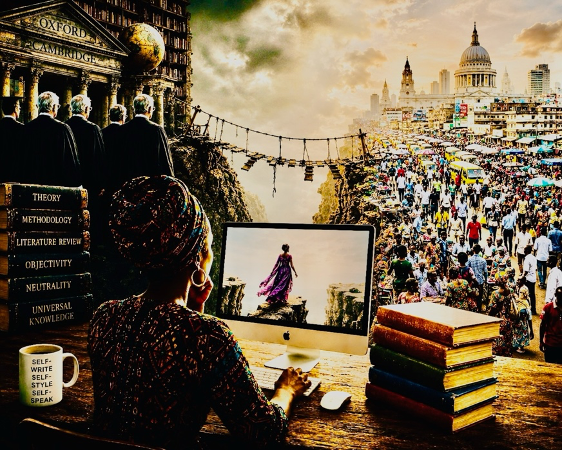
Down with the binary. Long live the binary!