

Mary Sibande is a black South African artist activist. Donna Haraway is
a white North American radical thinker. Two women. Different
generations and different a lot else. Mary turns the purple Apartheid
police weapon into a colour of resistance. A shift in power.
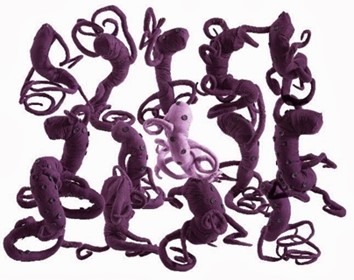
The Purple Shall Govern.
https://walkaboutartsa.wordpress.com/2014/07/30/colour-purple-sibande/
The Purple shall govern was a slogan coined by the people in
1989 after they had been sprayed by the apartheid police,
who laced their water cannons with purple dye to identify
them after the teargas, gun smoke and dust had settled. This
opens up ideas that are less representational and more
abstract. The work engages with anger, violent reactions and
a response to the bewildering apartheid and colonial after
taste. Mary Sibande, The Purple Shall Govern, Standard Bank Young Artists Award Winner Exhibition Catalogue, 2013.
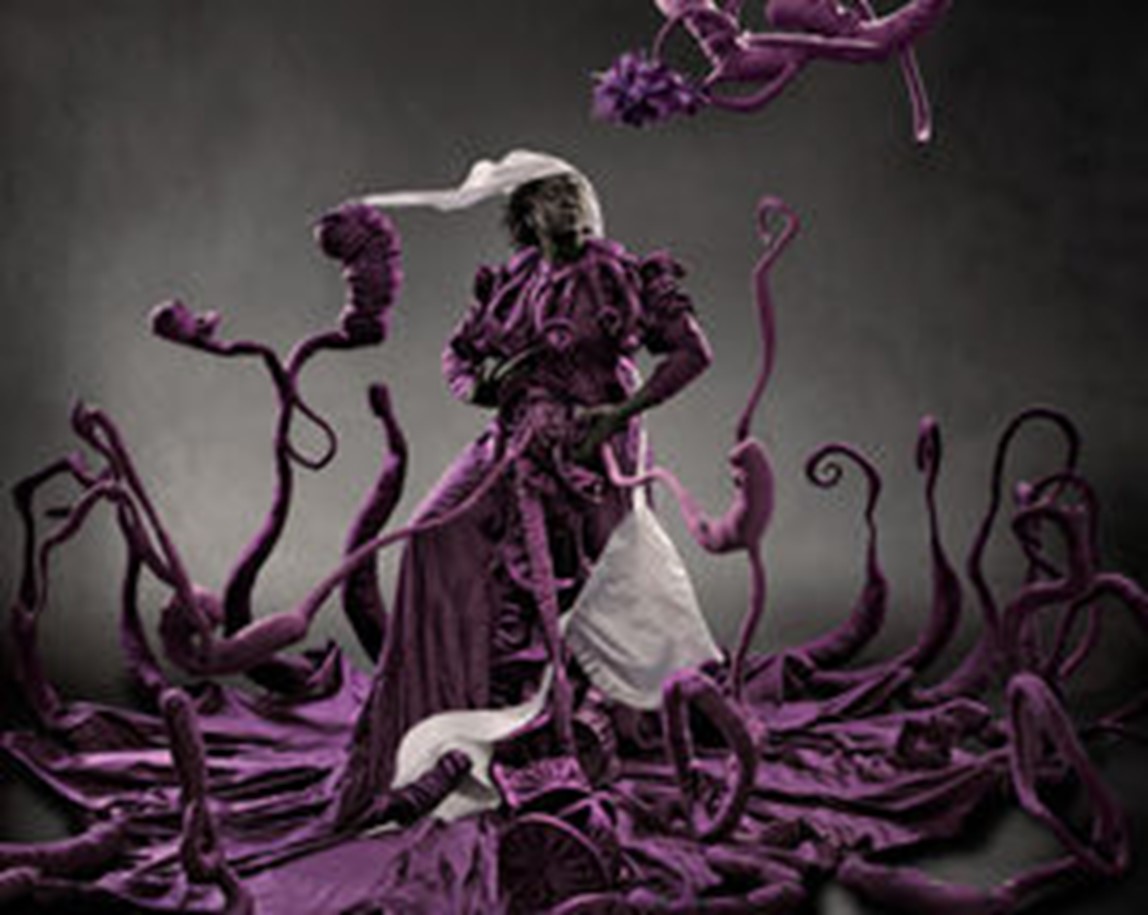
Mary’s masses of purple, powerful, indestructible, ropey figures riff on
Donna’s string figures, which are cross-species critters, multiple
rhizomes. They contest the singular world of power. They oppose the
hegemony of the nuclear, the hetero and the human.
The tentacular are not disembodied figures; they are
cnidarians, spiders, fingery beings like humans and raccoons,
squid, jellyfish, neural extravaganzas, fibrous entities,
flagellated beings, myofibril braids, matted and felted
microbial and fungal tangles, probing creepers, swelling
roots, reaching and climbing tendrilled ones. The tentacular
are also nets and networks, IT critters, in and out of clouds.
Tentacularity is about life lived along lines—and such a wealth
of lines—not at points, not in spheres. Donna Haraway. Staying with the Trouble, 2016
Both are fiercely committed to the power of women to enact change.
This is Sophie, Mary’s alter-ego.
Donna Haraway and Mary Sibande, in an overlapping moment,
combusts borders.